
Weakley County Parole and Probation
Tennessee divides parole decisions from field supervision. The Tennessee Board of Parole conducts hearings and decides parole matters. TDOC Community Supervision manages both parole and probation in the community. The official TDOC types of release define the state routes. Parole is conditional release from incarceration before the full sentence expires. A parole grant alone does not open the prison door. The release plan and any pre-release conditions must be approved before physical release occurs.
Probation is community supervision imposed through a court sentence. It may replace incarceration or follow a period of split confinement, which combines jail time with community supervision. TDOC says a person placed on probation must report within 48 hours after placement or release. That reporting rule does not establish the actual Weakley County jail release time, and the court docket may show the order before jail staff finish processing it.
| Feature | Parole | Probation |
|---|---|---|
| How it begins | Conditional release after incarceration | Community supervision ordered by a court |
| Decision source | Tennessee Board of Parole | Sentencing court |
| Field supervision | TDOC Community Supervision | TDOC Community Supervision |
| FOIL status | Parole | Probation |
| How it ends | Expiration, discharge, or a later legal action | Completion, discharge, or a later court action |
- Parole
- Supervision in the community after release from incarceration.
- Probation
- Court-ordered community supervision, sometimes after split confinement.
- Discharge
- The formal end of custody or supervision shown by the responsible agency.
- Absconded
- A failure to report while supervision remains active, not a completed sentence.
Verify Weakley County Supervision
The durable state starting point is Tennessee Felony Offender Information Lookup, known as FOIL. It includes felony offenders who are currently or formerly in TDOC custody or supervision. A county-only detainee who bonded out on a local charge may never appear there. Search the exact person and compare identifiers before treating any result as a match.
- Search FOIL by last name and optional first name. Use a TDOC ID or SID when one is known, and complete the required CAPTCHA.
- Compare the photo, identifiers, offense, sentence, and originating county. A shared name is not enough.
- Read the status literally. Parole and Probation mean active community supervision; Inactive means the person is no longer under state supervision.
- Review location, sentence End, Eligibility, and hearing information together. Eligibility is only the earliest parole-consideration date.
- Use the District 61 office for a local supervision route when the matched record points to parole or probation in Weakley County.
- For an unclear Board outcome, check the official hearing channel or request the final decision record from the Board.
For a county jail event, the sheriff and court remain essential. The Weakley County released-inmate search path explains why a roster disappearance, court order, and implemented release are three different facts.
Weakley County District 61 Supervision
Weakley County has a local TDOC Community Supervision contact in Dresden. District 61 serves Carroll, Gibson, and Weakley Counties. It is a practical follow-up when FOIL shows a matched person as being on parole or probation. The office does not publish a public list of everyone supervised, and legal or safety limits may restrict what staff can disclose.
TDOC Community Supervision District 61
8593 Highway 22
P.O. Box 749
Dresden, TN 38225
Phone: 731-364-3147
Fax: 731-364-5646
The TDOC field-office directory shows the District 61 entry that serves Weakley County.
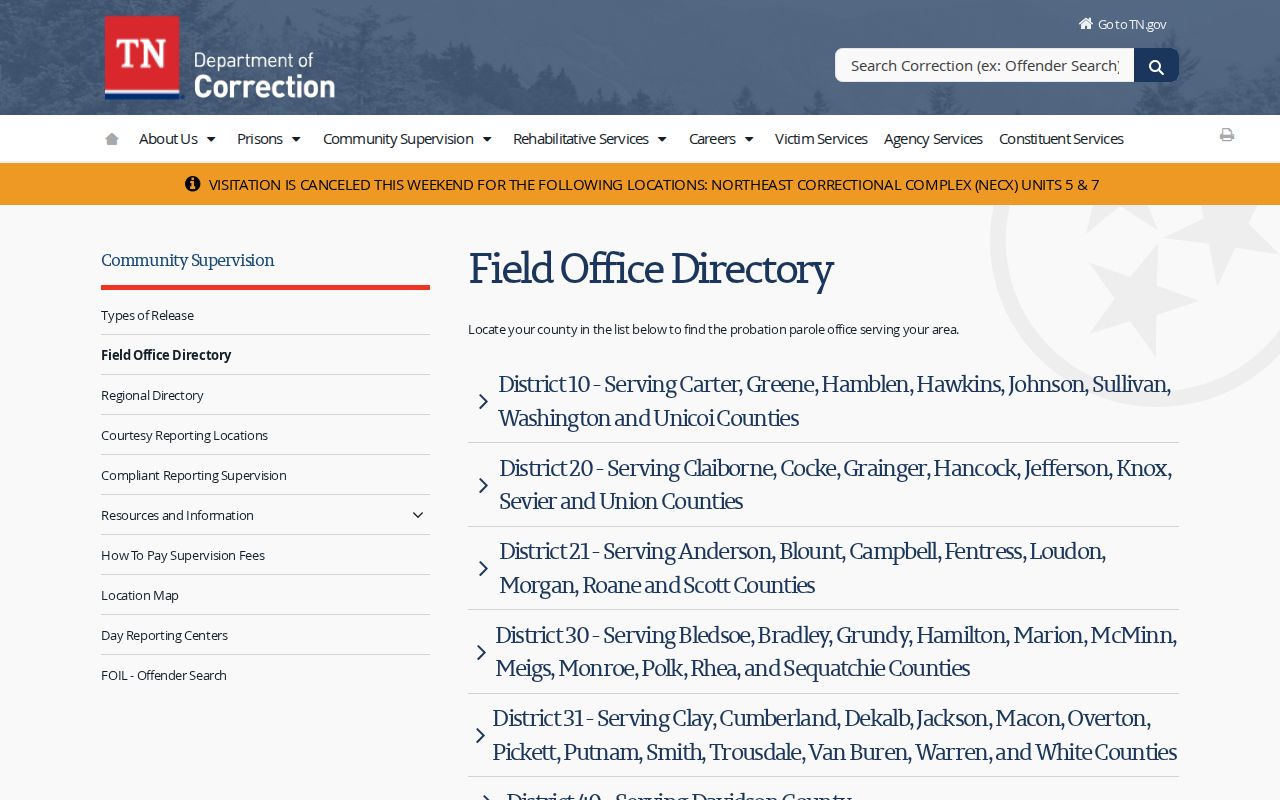
The office listing supplies the local route after FOIL establishes the state supervision status. It should not be used to replace identity matching or the underlying offender record.
When contacting District 61, use the TDOC number and the exact name shown in FOIL. Ask which public office can confirm the status or correct an error. Do not expect field staff to explain a county court order they did not create. That question belongs with the Circuit or General Sessions clerk.
Note: District 61 verifies the local supervision route, while the Board decides parole and TDOC maintains the offender record.
Weakley County Parole Hearing Records
The Board hearing schedule hub states that state-prison and county-jail schedules update weekly on Monday, or Tuesday after a Monday holiday. The current channel instructs users to request a schedule copy at BD.HearingSchedules@tn.gov. Schedules can change, so the Parole Hearings Division at 615-741-1150 is the confirmation point.
The Board's Parole Hearings Division describes grant, revocation, custodial, rescission, time-setting, and appeal proceedings. A hearing officer makes a recommendation. Board members may adopt, modify, or reject it. FOIL can show hearing information and such result terms as Continued, Declined, Parole, Revoked, and Serve, but the research found no separate public statewide decision-results search.
A denied, revoked, or rescinded decision may be appealed on the limited grounds in the Board appeal procedure. The deadline is 45 days after final-decision notice reaches the offender. An appeal does not change custody unless the Board changes its action and release is later implemented.
The official Board records-request channel is the fallback for a final decision. A request should identify the person and TDOC number, name the desired record, and meet the Board's requester requirements. The Board says it may charge for copies and should issue a response or timing notice within seven business days.
The weekly schedule image below comes from the Tennessee Board of Parole schedule page.
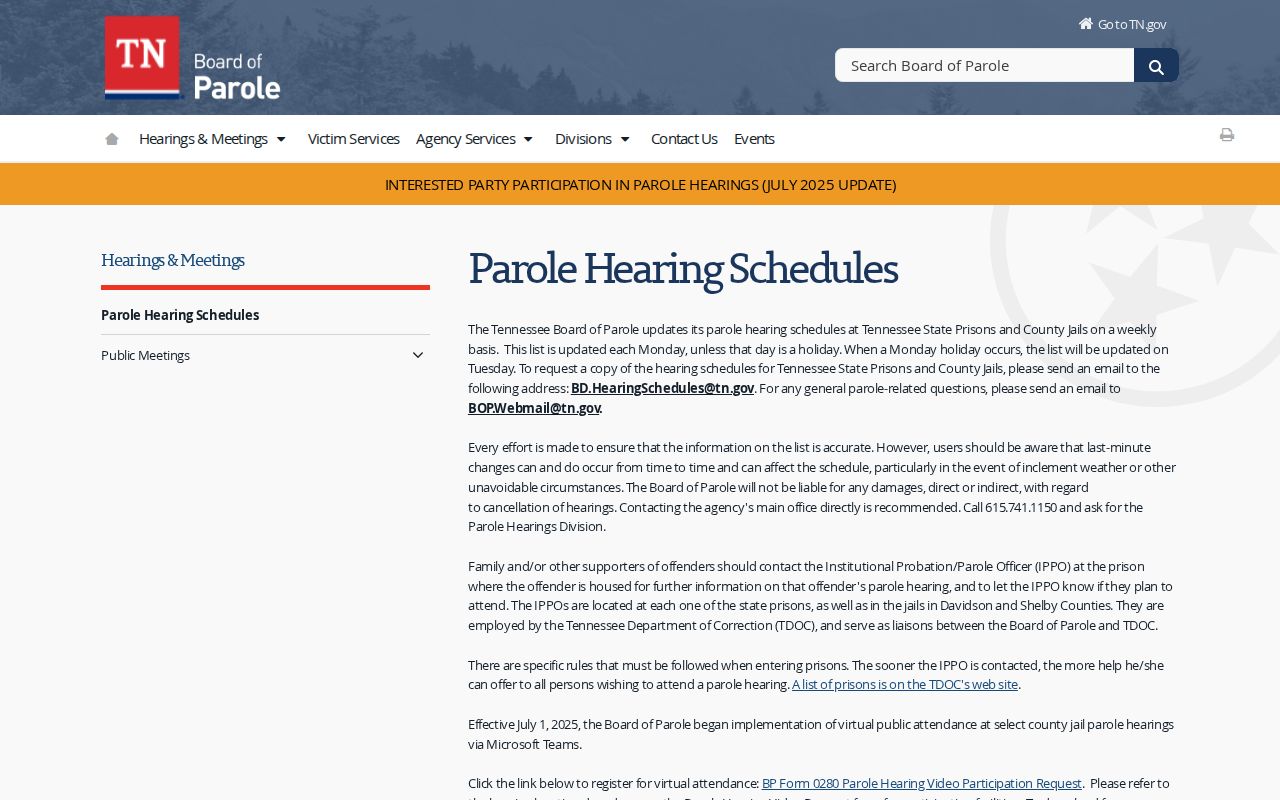
The posted cadence helps locate a proceeding, but the final Board action and later TDOC release record control the actual outcome.
Weakley County Probation Violation Status
FOIL uses Absconded for a failure to report. That label means supervision has not ended. It must not be read as discharge, successful completion, or proof of a new arrest. A warrant or revocation case may follow, but no official Weakley County sheriff absconder list was found in the research.
Check the precise source. FOIL shows the TDOC status. The Board handles parole revocation proceedings. The Weakley court portal can hold local docket entries. An official warrant channel can confirm a warrant when public access permits. A social post or secondhand report does not replace any of those records.
| Absconded | Failure to report while supervision remains active. |
|---|---|
| Revoked | A formal action ending the current release status and potentially returning the person to custody. |
| Inactive | FOIL's term for no longer under state supervision. |
| Out on Bond | Released pending further court action, not probation discharge. |
VINE may provide a later custody-change alert, but it is not a universal supervision-status archive. Use the named agency's record for the legal status. A transfer, warrant, or revocation can also mean that a once-correct community status has changed.
Note: Record the agency and retrieval date whenever a Weakley County supervision status may affect a time-sensitive legal or safety decision.
Correct Weakley County Supervision Records
A correction should go to the office that created the disputed record. A sheriff release-entry error belongs first with Sheriff Terry McDade's Weakley County Sheriff's Department. A judgment or docket error belongs with the Circuit or General Sessions clerk. FOIL identity, sentence, or status issues belong with TDOC. A final parole decision question belongs with the Board.
Older county materials may have moved to Weakley County Archives, but the posted page gives conflicting hours. Call 731-364-2163 before visiting the archive at 8250 Highway 22 in Dresden. Archives is not a same-day supervision desk. Its role is older county records, while a current parole or probation question begins with FOIL and District 61.
Keep copies of the disputed record, the source URL, retrieval date, identifiers used, and any written response. Do not assume that changing one database changes every agency copy. Court, sheriff, TDOC, Board, and archive records have different creators and correction paths.
Weakley County Supervision Discharge
Supervision ends only through the responsible legal process. FOIL defines Inactive as no longer under state supervision. A sentence End date can help interpret the record, but a future date may change through credits, amended judgments, revocation, appellate action, or recalculation. A blank or missing field is not a discharge.
Parole and probation remain distinct through completion. The Board's role concerns parole decisions; TDOC carries out field supervision and sentence management. The sentencing court remains central to probation orders and later court action. For a final parole record that FOIL does not resolve, use the Board's written public-records request route.
Determinate release is another Tennessee term that must not be mistaken for ordinary discharge. TDOC describes it as a specialized form of probation for an eligible felony term of at least one year and no more than two years after at least 30 percent has been served, subject to the notice and objection process in § 40-35-501. That narrow rule does not apply to every Weakley County sentence. Read the judgment and the official status instead of using the provision as a general date formula.
A Tennessee offender may also be under interstate supervision. FOIL help says an out-of-state parolee or probationer living in Tennessee may appear in the TBI Out-of-State Parole and Probation Supervision Registry instead of FOIL. That limited registry is not a general released-inmate list. Match the correct system before drawing any conclusion from an absent result.
A final check should preserve the status as the agency states it. Record the FOIL retrieval date, TDOC number, status, End field, and supervising-office route. If the court record and FOIL disagree, ask each record creator about its own entry. Discharge from one duty does not erase the historic court or custody record, and an unavailable record may reflect a lawful restriction rather than proof that supervision never existed.